How To Select Correct LED UV Lamp For Fluorescent Inspection
Arora Technologies (P) Limited
The success of any non-destructive evaluation involving fluorescent inspection is highly dependent on the effective UV Lamp complying to the international standards and meeting the industry norms. With the advancement in technology the industry has adapted the high intensity LED UV-A light sources as go-to solution for NDT Professionals.
The adoption of LED technology not only brings forth enhanced safety and flexibility but also demands a nuanced understanding of its performance in Non-Destructive Testing. To ensure the apt choice of a lamp for fluorescent inspection, meticulous attention must be given to several factors in accordance with ASTM E3022. This holistic approach is integral in optimizing the effectiveness of UV lamps in NDE applications.
Important Factors in Choosing the Correct UV Lamp
Peak Wavelength:
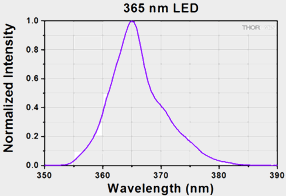
To ensure that an LED UV-A lamp produces fluorescence in penetrants and magnetic particle materials, the LEDs must have a peak wavelength within the range 360 – 370 nm as measured with a spectroradiometer in accordance to ASTM E-1444. Wavelength is a dominating factor as lower wavelengths may emit UV-B/UV-C which cause serious health issues.
Also, greater wavelengths may emit excess of visible light forming deep violet glare. Sometimes to block visible emission (Deep violet glare) UV-A pass filter is used, particularly for inspection in Aerospace industry.
UV-A and Visible Light Intensity:
In accordance with ASTM E1444/E1444M, Black Light or UV Lamps must produce a minimum acceptable intensity of 1000 μW/cm2 at 15 inch [38.1 cm] from the front of the filter to the face of the sensor. If the UV light produces more than the accepted ambient visible light, then it causes risk of missing critical indications. Ambient visible light produced by the Lamp during Fluorescent magnetic particle examinations in a darkened area can have a maximum ambient light level of 2 fc [22 lx] measured at the part surface.
Both the UV and Visible intensity shall be checked with meters that are to be calibrated every 6 Months by the manufacturer or by any Nationally accredited laboratory.
Beam Irradiance Profile Emitted by the Lamp:
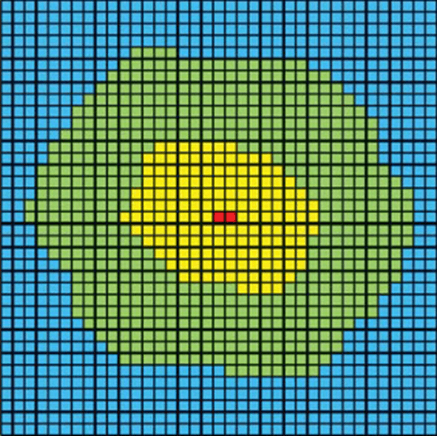
The UV Lamp must emit a uniform beam with the beam irradiance profile in accordance with ASTM E3022 from a distance of 15 ± 0.25 inch [38.1 cm] above the surface of a flat, level workbench with the projected beam orthogonal to the workbench surface. This is to ensure that a in a given area, the UV Light is rationally distributed so as to avoid any chance of missing critical surface defects.
Example of Beam Irradiance Profile
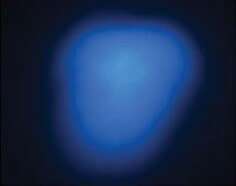
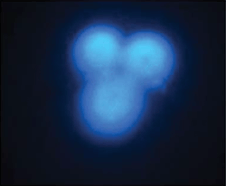
Example of Uniform and Non-Uniform Projected Beam
Beam Irradiance Pattern & Profile
Blue <200 μW/cm2
Green 200-1000 μW/cm2
Yellow 1000-5000 μW/cm2
Red 5,000 – 10,000 μW/cm2
White > 10,000 μW/cm2
LED UV Lamps
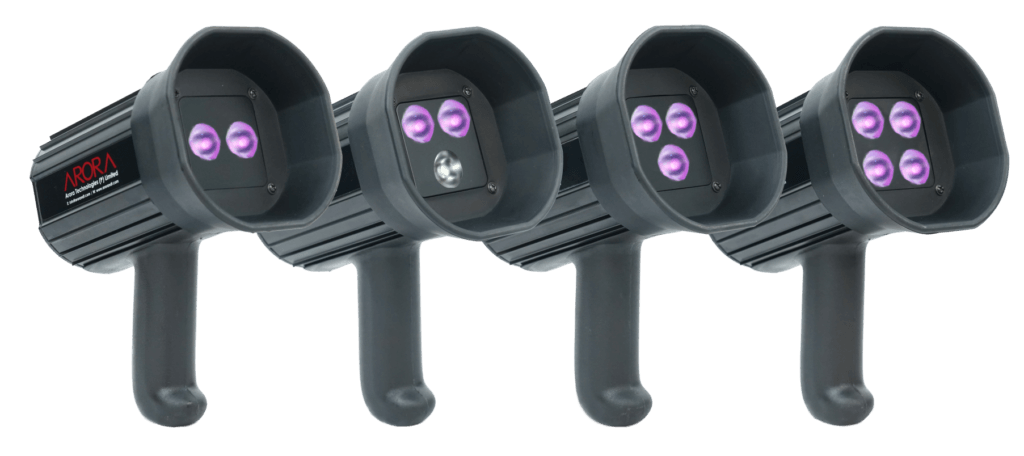
We manufacture highest quality of LED UV Products in accordance with international standards ASTM E3022. The AUL Series of LED UV Lamps are considered to be the benchmark in the NDT Industry.These Lamps are light weight, rugged and cost effective which makes them a perfect combination to be used for Fluorescent Inspection.
Our Current Offering Includes :
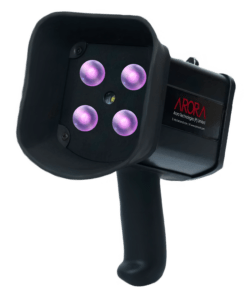
AUL Series – LED UV Handheld Lamps
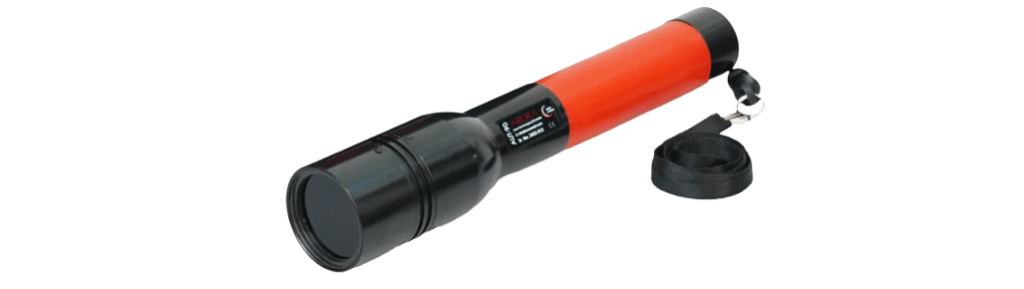
AUT 90 – LED UV Torch
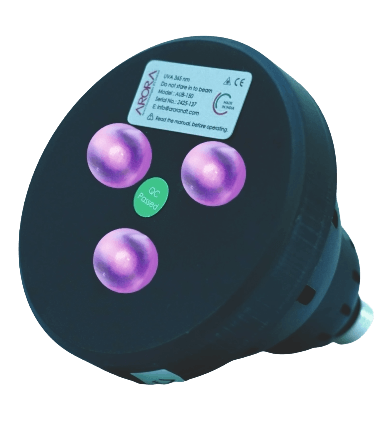
AUB 150 – LED UV Bulb
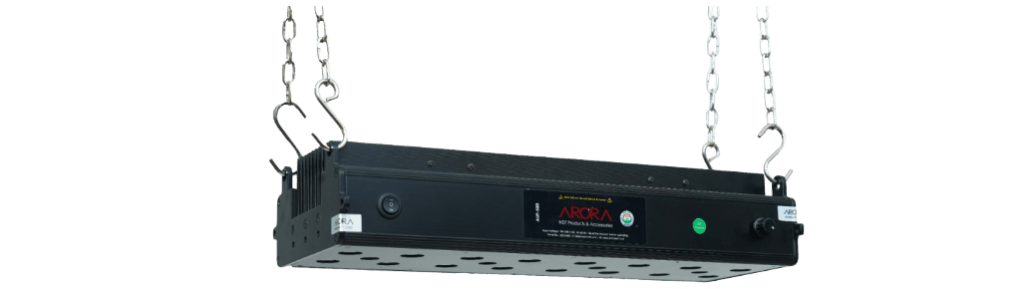
AUF Series – LED UV Flood Lamps
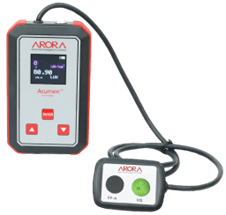
UV-A Meter – Acumen365
The Acumen365 is a battery powered handheld UV-A meter/photometer used to measured ultraviolet – A light, used for fluorescent inspection (non-destructive testing).
The compact size, shape and its lightweight make this device ideal to use for applications in industrial plant or in the research labs, where the intensity measurement of UV-A and visible lights is required.